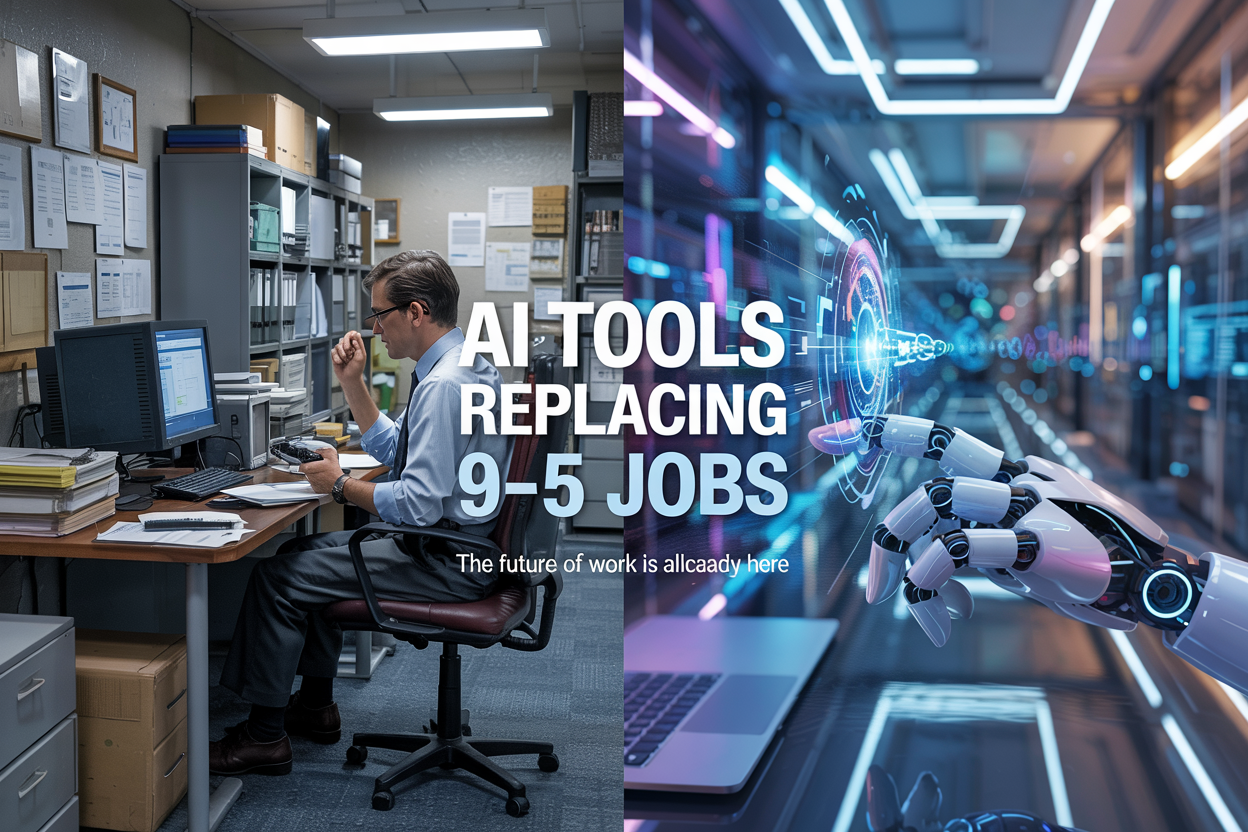
The idea of artificial intelligence replacing a traditional 9–5 job once sounded dramatic. Today, it sounds realistic.
Across the United States, businesses are quietly restructuring how work gets done. Not by firing entire departments overnight, but by trimming the repetitive layers inside those roles. The result isn’t chaos — it’s efficiency.
The modern workplace is no longer built purely around human effort. It is increasingly built around systems.
And AI sits at the center of those systems.
The Real Meaning Behind “AI Replacing 9–5 Job”
A 9–5 job is rarely one single responsibility. It’s a bundle of tasks — emails, reports, scheduling, analysis, documentation, coordination, follow-ups.
When artificial intelligence enters the picture, it doesn’t erase a job title. It targets the predictable pieces inside that title.
Repetitive tasks.
Structured workflows.
Rule-based decisions.
Data processing.
As those layers become automated, the shape of the job changes.
That shift is already visible in marketing teams, finance departments, customer service centers, and administrative offices across the country.
AI Writing Systems Reshaping Content Roles
Content creation used to require full teams of junior writers drafting blogs, product descriptions, and email campaigns. Today, advanced AI writing platforms can generate structured drafts in seconds.
This reduces dependency on entry-level drafting roles while increasing the value of editors, strategists, and brand managers who refine and guide the output.
The work still exists.
The process has changed.
Automation Platforms Replacing Operational Busywork
In many companies, entire roles were built around moving information from one system to another.
Updating spreadsheets.
Sending confirmation emails.
Transferring CRM data.
Triggering notifications.
Modern automation platforms now perform these actions instantly once configured.
What once required daily human oversight now runs quietly in the background.
Administrative coordination has shifted from manual execution to system supervision.
AI in Meetings and Internal Communication
Meetings once required note-takers, documentation specialists, and follow-up coordinators.
AI tools now record conversations, transcribe discussions, generate summaries, and highlight action points automatically.
The outcome is faster documentation and fewer manual roles dedicated solely to recording information.
Human presence in meetings is becoming more about decision-making than documentation.
Customer Support and Conversational AI
Customer service has experienced one of the most visible AI transformations.
Modern AI systems handle:
Order tracking
Refund processing
Basic troubleshooting
Frequently asked questions
Instead of eliminating support teams entirely, businesses restructure them. AI manages routine inquiries while human representatives focus on complex or emotionally sensitive cases.
The entry-level layer shrinks.
The specialized layer becomes more valuable.
Financial and Analytical Automation
In accounting and finance, artificial intelligence can now categorize transactions, flag inconsistencies, generate reports, and forecast trends.
Routine bookkeeping tasks that once required hours of manual review are now completed in moments.
However, strategic financial planning, interpretation of trends, and executive decision-making remain human-centered responsibilities.
AI handles patterns.
Humans handle judgment.
Roles Most Vulnerable to Automation
Jobs built around repetition and predictability face the highest exposure.
Data entry positions
Basic administrative assistants
Telemarketing roles
Appointment scheduling
Entry-level content drafting
Standardized reporting
The common denominator is structure. When a role follows a consistent pattern, AI can often replicate it.
This pattern explains why early-career office roles are evolving the fastest.
Roles That Remain Resilient
While automation accelerates, certain categories remain resistant to full replacement.
Positions requiring emotional intelligence, leadership, negotiation, physical skill, or complex human interaction continue to rely heavily on human capability.
Healthcare professionals
Skilled trades
Therapists
Strategic sales professionals
Executive leaders
These roles involve nuance and unpredictability — areas where AI remains limited.
Assistance is possible.
Replacement is far less likely.
The Bigger Workplace Shift replacing 9–5 Job
The conversation around AI often centers on fear — job loss, redundancy, instability.
The more accurate narrative is transformation.
Companies are not eliminating work.
They are redesigning it.
Teams become smaller.
Output becomes faster.
Efficiency increases.
Decision-making becomes more centralized.
The traditional 9–5 model built on routine execution is gradually giving way to a model built on oversight, creativity, and system management.
The demand is moving upward — from task completion to strategy.
A New Definition of Professional Value
In an AI-integrated workplace, value is no longer measured by hours spent on repetitive tasks. It is measured by:
Problem-solving ability
Strategic thinking
Adaptability
Leadership
Creative direction
System design
As automation expands, the workforce polarizes. High-skill contributors who understand systems become more influential. Purely task-based roles become more vulnerable.
Artificial intelligence does not erase ambition or intelligence. It amplifies efficiency.
And efficiency reshapes hierarchies.
Is the Traditional 9–5 Job Disappearing?
Not entirely.
But its structure is changing.
The rigid model of manual execution from 9 a.m. to 5 p.m. is evolving into something more hybrid — human insight supported by machine precision.
Artificial intelligence tools are already replacing portions of traditional workdays across industries. Writing, scheduling, reporting, data processing, and first-level customer interaction have all shifted toward automation.
The transformation is no longer theoretical.
It is operational.
Final Perspective
AI tools are not arriving in the future.
They are embedded in current workflows.
They reduce repetitive effort, streamline operations, and increase output per employee. Businesses adopt them not out of curiosity, but out of competitive necessity.
The modern 9–5 job is not vanishing overnight.
It is being rebuilt — layer by layer.
And the workplace that emerges will not eliminate humans.
It will simply demand more from them.