

Picking between Upwork and Fiverr in 2026 feels like a coin flip until you see what each platform actually keeps from your paycheck. We pulled the real numbers, ran the math on real freelancer scenarios, and tested both platforms ourselves over the last year. The short answer surprised us. The longer answer matters more, because the wrong choice can cost you a third of your earnings before you ever cash out.
This Upwork vs Fiverr 2026 breakdown is built for side hustlers who want the truth, not a sales pitch from either company.
The Quick Answer Before You Scroll Further
For most beginners in 2026, Upwork pays more per dollar earned because of its lower service fee (0% to 15%, most pay around 10%) compared to Fiverr’s flat 20%. But Fiverr gets you to your first sale faster because clients come to you instead of you chasing them. So the real answer depends on whether you have time to send proposals or whether you’d rather wait for buyers to find your gig.
Keep reading. The math changes once you factor in Connects, withdrawal fees, and the small order fee Fiverr charges buyers on anything under $50. That’s where the 20% headline rate quietly turns into something closer to 30%.

How Upwork Actually Works in 2026
Upwork is a proposal-based marketplace. Clients post a job, you write a pitch (called a proposal), and they pick from the applicants. You set your own hourly rate or fixed price. The platform takes a cut when you get paid, and pays out 5 to 10 days after the work clears, depending on contract type.
Here’s what changed in May 2025 that most older articles get wrong: Upwork scrapped its old tiered fee model (20% on the first $500 with a client, 10% up to $10K, 5% above) and replaced it with a variable 0% to 15% service fee set per contract. According to Upwork’s official support documentation, the fee ranges from 0% to 15% per contract and helps cover payment protection, fraud prevention, dispute resolution, and other platform tools. Most freelancers I’ve talked to in the past six months are seeing rates that cluster around 10%, which lines up with the third-party data tracking these contracts. Upwork
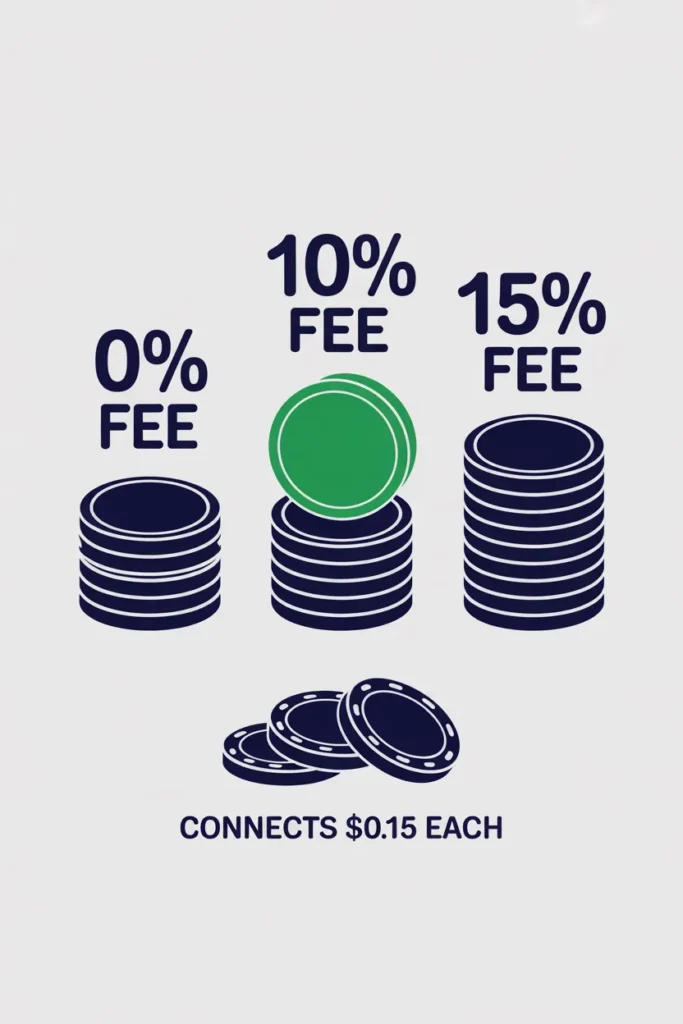
You also need to know about Connects. These are virtual tokens you spend to submit proposals. Each costs $0.15, sold in 10-packs. A standard proposal burns anywhere from 6 to 16 Connects depending on the job category and whether you boost your bid. Free accounts get 10 Connects per month. Freelancer Plus runs $19.99/month for 100 Connects, full access to Upwork’s AI assistant Uma, and a few other perks.
The Hidden Cost Nobody Mentions on Upwork
Connects are a sunk cost. Spend them on a proposal, lose the job, and that money is gone. If you send 30 proposals at an average of 10 Connects each and land 2 clients, you’ve spent $45 in Connects to win those contracts. Budget for them like you’d budget for ads.
How Fiverr Actually Works in 2026
Fiverr flips the model. Instead of you applying to jobs, buyers come to your gig listing. You package your service into tiered offerings (basic, standard, premium), set the price, and wait for orders. Sounds passive. It isn’t. Visibility on Fiverr is a full-time job in itself.
Fiverr’s seller fee is brutally simple: a flat 20% on every order, every tip, every gig extra, with zero tiers and zero exceptions. Fiverr charges sellers a flat 20% commission on every order, including tips, with no tiers, no volume discounts, and no exceptions, whether you earn $5 or $5,000 on a single order. Freelancecompare
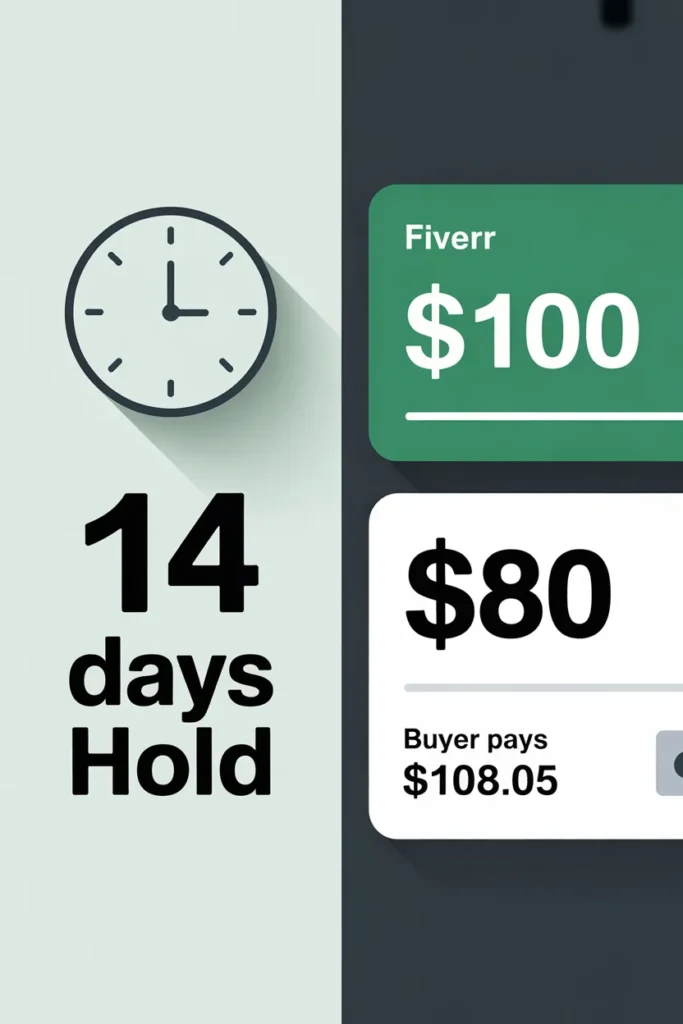
But the 20% headline rate is misleading because buyers pay their own layer of fees, and those fees affect what clients are willing to spend on your gig. Buyers pay an extra 5.5% service fee plus a $2.50 small order fee on anything under $50. When you factor in buyer-side fees that affect your pricing power, plus withdrawal costs and currency conversion, Fiverr’s effective take rate ranges from 24% to over 35% depending on order size. Freelancecompare
Payment timing also hurts cash flow. Funds sit in pending status for 14 days (7 days for Top Rated Sellers, Pro sellers, and Seller Plus Premium members) before you can withdraw.
Upwork vs Fiverr 2026 Fee Comparison Table
Here’s the side-by-side most articles skip. These numbers reflect what you actually keep, not the marketing version.
| Cost Layer | Upwork 2026 | Fiverr 2026 |
|---|---|---|
| Seller service fee | 0% to 15% (most pay ~10%) | Flat 20% |
| Cost to apply | $0.15 per Connect, ~6 to 16 per proposal | $0 (clients come to you) |
| Buyer-side fee | 3% to 10% (paid by client) | 5.5% + $2.50 small order fee under $50 |
| Optional upgrade | Freelancer Plus $19.99/mo | Seller Plus $29/mo or Premium $39/mo |
| Withdrawal fee | $0 ACH (US), $1 direct deposit, $30 wire | $1 to $3 (direct deposit / wire); PayPal free but 2 to 4% conversion |
| Payment hold | 5 to 10 days after work clears | 14 days (7 for Top Rated) |
| Effective take rate | 11% to 14% all-in for most | 24% to 35% all-in |
The all-in numbers are what matter. Two freelancers earning the same gross can take home wildly different amounts depending on which platform processes the money.
Real Take-Home Math: $1,000 Earned on Each Platform
Let’s run the numbers on a freelancer earning $1,000 gross per month. I built this calculator from the official fee structures published by both platforms.
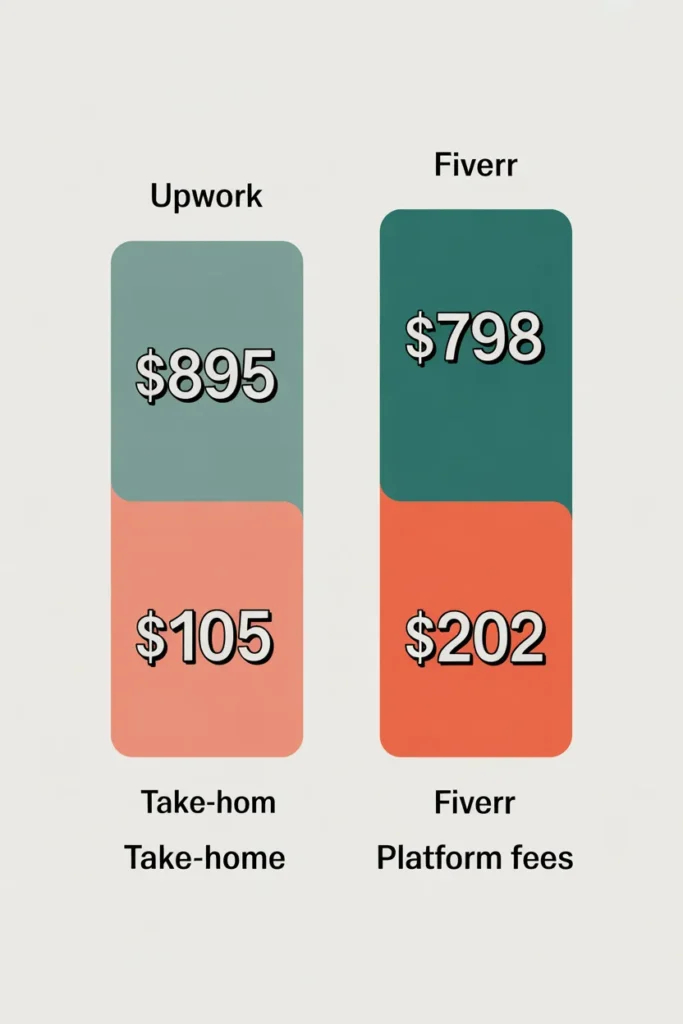
Upwork scenario ($1,000 gross from a single ongoing client at 10% service fee):
- Gross earnings: $1,000
- Upwork service fee (10%): minus $100
- Connects to win the job (estimated 30 burned): minus $4.50
- ACH withdrawal: $0
- Take-home: $895.50 (89.5% of gross)
Fiverr scenario ($1,000 gross across ten $100 orders):
- Gross earnings: $1,000
- Fiverr service fee (20%): minus $200
- Withdrawals (assuming bank transfer at $1 each, two per month): minus $2
- Take-home: $798 (79.8% of gross)
That’s a $97.50 monthly difference for the same gross revenue. Across a year that’s $1,170 you keep on Upwork that Fiverr would have taken. For a side hustler clearing $2,000 to $3,000 a month, the gap widens to roughly $2,400 to $3,600 per year.
Skill-to-Platform Matching Matrix (Original Framework)
Here’s the angle no competitor covers. Different freelance skills perform dramatically better on one platform than the other because of how buyers behave on each. We’ve matched the most common side hustle skills to their better-fit platform.
| Skill | Better Fit | Why |
|---|---|---|
| Logo design | Fiverr | Buyers want fast, fixed-price, package-based delivery |
| WordPress / web development | Upwork | Higher-budget, ongoing retainer clients |
| Freelance writing (blog posts) | Either, but Upwork for retainers | Fiverr good for one-offs, Upwork for recurring content |
| Voice-over work | Fiverr | Quick gigs with sample audio drive conversions |
| Bookkeeping | Upwork | Monthly retainer relationships dominate |
| Social media management | Upwork | Ongoing monthly contracts, higher LTV |
| Video editing (short form) | Fiverr | Package tiers map perfectly to short content |
| Translation | Upwork | Buyers want vetted, hourly-billed pros |
| Resume writing | Fiverr | Buyers want a clear price and turnaround |
| Virtual assistant work | Upwork | Long-term hourly contracts beat one-off tasks |
| Graphic design (one-off) | Fiverr | Visual gig samples convert browsers to buyers |
| Web design (full builds) | Upwork | Larger budgets, longer timelines |
| Data entry | Upwork | Higher hourly volume from business clients |
Screenshot this if it helps. The pattern: Fiverr rewards packageable, fixed-price, visual or sample-driven work. Upwork rewards ongoing relationships and skill-heavy work that buyers want vetted before they hire.
Buyer Intent: The Hidden Difference That Decides Everything
This is the angle that matters more than fees, and it’s barely covered anywhere. Upwork buyers are usually businesses solving an ongoing problem. Fiverr buyers are usually individuals or small teams buying a quick deliverable.
That difference changes everything about your income.
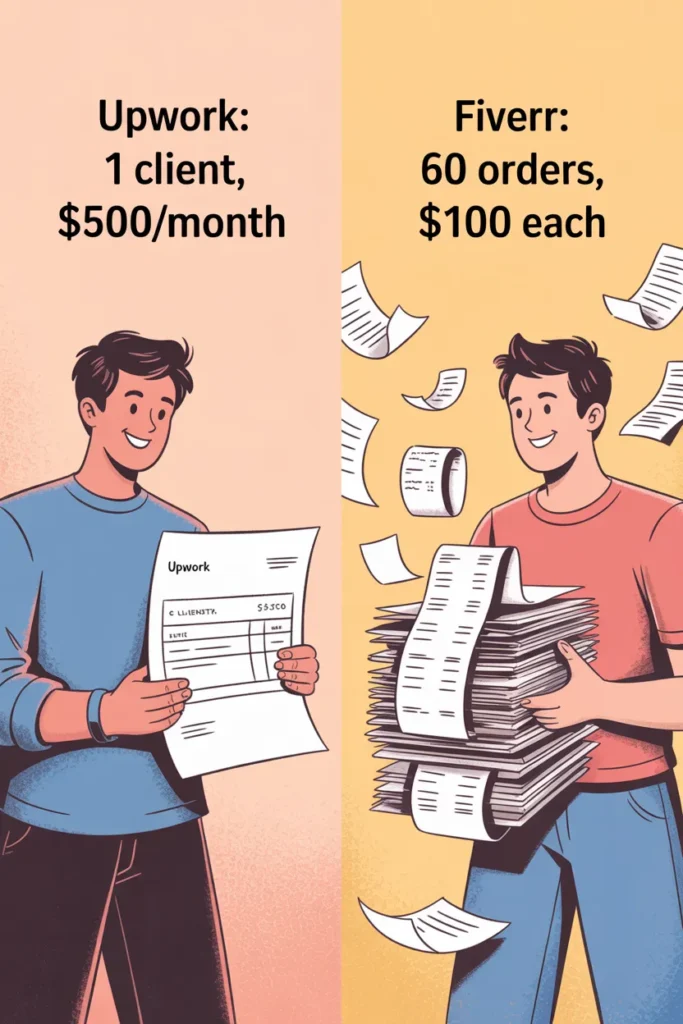
On Upwork, a graphic designer might land one client and bill them $500/month for a year. That’s $6,000 from a single sales effort. On Fiverr, the same designer needs to win 60 separate $100 orders to hit the same revenue, with all the customer support, revisions, and review-management work that comes with it.
For side hustlers who want recurring revenue with minimal sales effort once they’re set up, Upwork wins. For side hustlers who want fast first sales and the freedom to take or leave each order, Fiverr wins.
The 90-Day Launch Roadmap for Each Platform (Original Framework)
If you’re starting from zero, here’s the week-by-week plan to your first $1,000 on each side.
Upwork 90-Day Roadmap
Days 1 to 14: Profile foundation
- Pick one skill, not five. Buyers reward specialists.
- Write a profile headline that names the result you deliver, not the title you hold.
- Add at least three portfolio pieces, even if they’re spec work.
- Set your hourly rate 15% above the average for your category. Then never apologize for it.
Days 15 to 45: First proposals
- Send 5 to 8 proposals per day, Monday through Friday.
- Customize every first paragraph. No copy-paste templates.
- Bid on smaller jobs ($100 to $500) first to build reviews.
- Aim for your first Job Success Score by week 6.
Days 46 to 90: Retainer transition
- After your third good review, raise your rate 10%.
- Ask happy clients about ongoing monthly work, not just one-off projects.
- Apply for the Top Rated badge once you hit the criteria.
- Build a saved-proposal library for fast pivots.
Fiverr 90-Day Roadmap
Days 1 to 14: Gig setup
- Create three gigs, not one. Test which one buyers click.
- Use gig images that show the deliverable, not stock photos.
- Price your basic package at $25 minimum to dodge the $2.50 small order fee penalty on the buyer side.
- Write your gig description like a sales page, not a resume.
Days 15 to 45: First orders
- Respond to every message within an hour during your first month.
- Over-deliver on early orders to bank five-star reviews.
- Add gig extras (faster delivery, extra revisions, source files) to boost order value.
- Reach Level 1 (10 completed orders, 60 days minimum) as your first milestone.
Days 46 to 90: Optimize and tier up
- Raise your basic package price 15% once you hit 10 five-star reviews.
- Test Fiverr Promoted Gigs on your highest-converting listing only.
- Build out a Premium tier at 3 to 5 times your basic price.
- Push toward Level 2 (50 completed orders, 120 days) for better search visibility.
Pinterest Bonus: Want to Drive More Freelance Clients Through Pinterest?
If you’re using Pinterest to drive traffic to your freelance services or a portfolio site, internal linking matters. Our guide on freelance side hustles that pay weekly walks through the highest-paying gigs and pairs well with this comparison.
Tax and Legal Notes for US Freelancers (2026)
A few things every side hustler on either platform needs to know about the tax side. This is general info, not tax advice. Talk to a qualified US tax professional for your specific situation.
- Both platforms issue 1099-K forms if you exceed the IRS reporting threshold. For 2026, that threshold is $2,500 in total platform payments, per the latest IRS phase-in schedule. Verify the current threshold at irs.gov before filing.
- Self-employment tax kicks in at $400 of net earnings, regardless of platform.
- Quarterly estimated taxes are required if you expect to owe more than $1,000 in federal tax. Set aside 25% to 30% of every dollar of net profit in a separate account.
- Deductible expenses for platform freelancers include: Connects purchases (Upwork), Seller Plus subscription (Fiverr), software you use to deliver work, your home office (simplified method: $5/sq ft up to 300 sq ft), and a percentage of internet and phone bills.
For a deeper dive on quarterly taxes and write-offs, see our side hustle tax guide.

Common Mistakes Beginners Make on Both Platforms
After watching friends and readers go through their first six months on each platform, the same five mistakes keep showing up. Don’t make them.
- Pricing at what you want, not what the platform takes. If you want $100 net on Fiverr, list at $125. If you want $50/hour net on Upwork at 10%, bill $55.55/hour. Most beginners learn this after their third invoice clears.
- Sending generic proposals or messages. Both platforms reward customization. On Upwork, the first two sentences of your proposal decide if the client reads the rest. On Fiverr, the first reply to a buyer inquiry decides if they order.
- Going too broad. “I can do anything” reads as “I’m not great at anything.” Niche down. A WordPress developer who only builds Shopify migrations will out-earn a generalist every time.
- Ignoring reviews early on. Your first 10 reviews on either platform are worth more than your next 100. Treat early gigs like portfolio investments, not paychecks.
- Quitting before week 8. Both platforms have algorithms that reward consistency. Most accounts that fail simply stopped showing up before the algorithm started favoring them.
Should You Use Both Upwork and Fiverr at the Same Time?
Yes, and honestly most serious freelancers eventually do. The two platforms serve different buyer pools, so running both doesn’t cannibalize your income. It expands it.
The catch: don’t try to launch both at once. Pick one, hit your first 10 completed contracts or orders, then bring the second platform online. Splitting your focus on day one is the fastest way to underperform on both.
Need a system to keep work organized once you’re juggling clients across platforms? Our freelance time management framework covers exactly that.
Industry Trends Shaping Upwork vs Fiverr in 2026 and Beyond
A few patterns worth watching as you build your freelance side hustle this year.
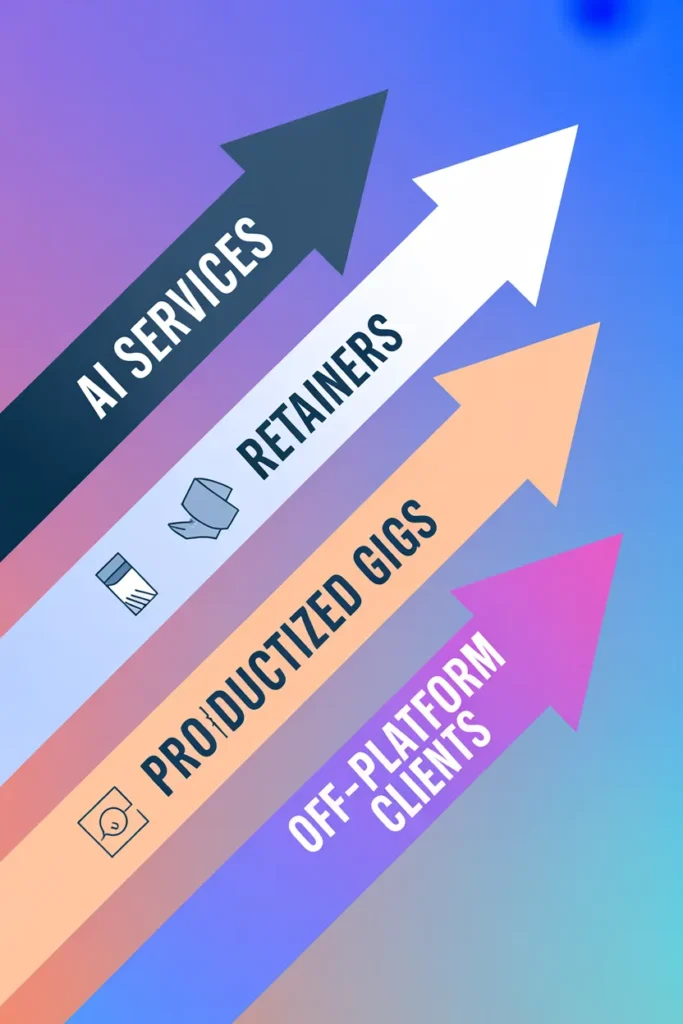
- AI services are the fastest-growing category on both platforms. Prompt engineering, custom GPT builds, and AI workflow automation are pulling in premium rates because supply hasn’t caught up with demand.
- Repeat-client revenue is increasingly valued on Upwork. The platform’s algorithm rewards freelancers with high client retention, which suggests retainers will continue to outperform one-off gigs.
- Fiverr is leaning harder into productized services. The platform is pushing tiered packages and gig extras because they boost average order value. Sellers who structure their gigs around clear deliverables win the algorithm.
- Off-platform client relationships are becoming standard. Most established freelancers eventually move their best clients off-platform after the initial contracts. Both platforms have rules against this, so read the terms before you ask a client to move.
Final Verdict: Which Pays Freelancers More in 2026?
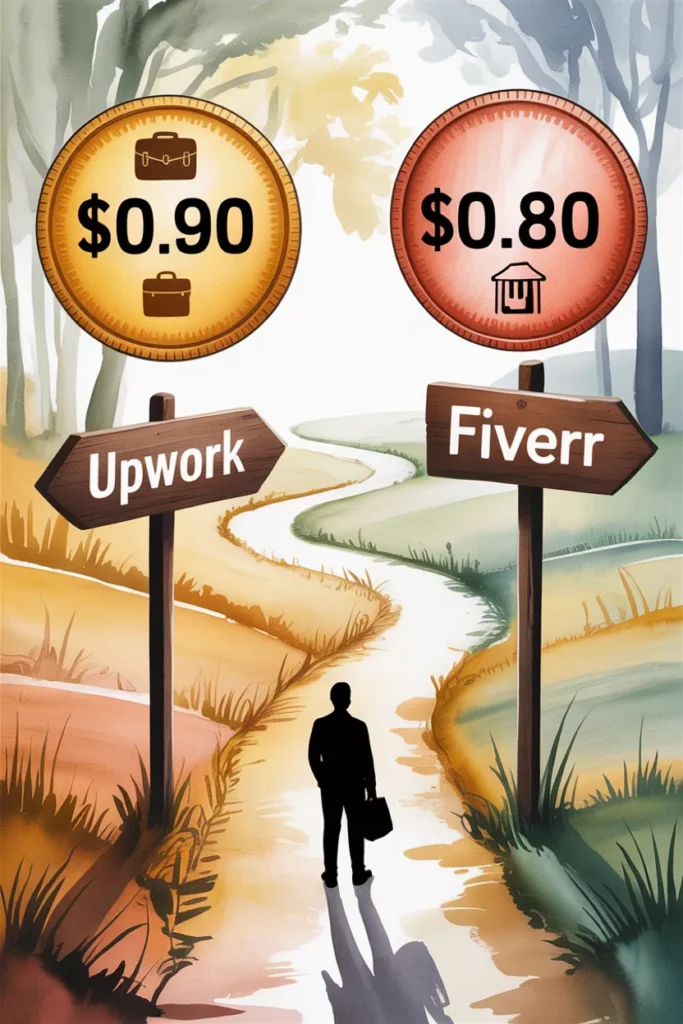
If you measure “pays more” by what you keep per dollar earned, Upwork wins for most freelancers in 2026 because of its lower service fee (most pay around 10% vs Fiverr’s flat 20%), no buyer-side fees that suppress your pricing power, and faster payment timing.
But Upwork demands sales effort. Connects, proposals, and pitching are part of the job. If you’re allergic to outbound sales, Fiverr’s “buyers come to you” model is worth the extra 10% to 15% Fiverr takes.
The smartest move for most side hustlers in 2026 is to start with the platform that matches your skill type (per our matching matrix above), give it 90 days of full effort, and then add the second platform once your first one is humming. Don’t chase both at once.
Frequently Asked Questions
Which gives more money, Fiverr or Upwork in 2026?
Upwork gives more money per dollar earned for most freelancers because it charges a 0% to 15% service fee (most cluster around 10%) compared to Fiverr’s flat 20%. Once you add Fiverr’s buyer-side fees and small order fee, Fiverr’s effective take rate climbs to 24% to 35%. On a $1,000 gross month, Upwork freelancers typically take home around $895, while Fiverr sellers take home around $798.
Which freelancing skill is in demand in 2026?
The fastest-growing freelance skills in 2026 are AI-related (prompt engineering, custom GPT builds, AI workflow automation), short-form video editing, technical writing for SaaS companies, Webflow and Shopify development, fractional bookkeeping, and cold email copywriting. AI services are growing fastest because demand outpaces supply, which keeps rates premium.
What is the #1 freelance website right now?
Upwork and Fiverr remain the two largest general-purpose freelance marketplaces by active users, with Upwork reporting 814,000 active clients in early 2026. Which one is “#1” for you depends on your skill, sales preference, and whether you want retainer work (Upwork) or productized gig sales (Fiverr). For ongoing client relationships, Upwork takes the top spot. For fast first sales, Fiverr does.
What type of freelancing makes the most money in 2026?
The highest-earning freelance niches in 2026 are AI consulting and implementation, B2B SaaS copywriting, enterprise web development, fractional CFO and bookkeeping work, paid advertising management, and cybersecurity consulting. Most of these top out higher on Upwork because they involve ongoing retainers rather than one-off gigs.
Is Fiverr or Upwork better for beginners?
Fiverr is faster to start with because you don’t write proposals, but Upwork pays better long-term because of lower fees and retainer-style clients. Beginners with quick, packageable skills (logo design, voice-over, resume writing) usually do better on Fiverr first. Beginners with skills that require trust-building (web development, bookkeeping, writing) usually do better on Upwork.
How much does Upwork take from freelancers in 2026?
Upwork takes a variable 0% to 15% service fee per contract, set when the proposal is sent and locked for the contract’s duration. Most freelancers report rates clustering around 10%. There’s also a Connects cost ($0.15 each, 6 to 16 per proposal) and optional Freelancer Plus subscription at $19.99/month. All-in costs typically run 11% to 14% of gross earnings.
What are the disadvantages of Fiverr in 2026?
The biggest disadvantages of Fiverr are the flat 20% commission (no tiers, no discounts), buyer-side fees that suppress your pricing power, the 14-day payment hold for new sellers (7 days for Top Rated), high competition that can bury new gigs, and a reputation for siding with buyers in refund disputes. Effective take rates of 24% to 35% are common once all fees are tallied.
Final Thought
The Upwork vs Fiverr 2026 debate isn’t really about which platform is better. It’s about which platform matches how you work. Spend ten minutes with the skill-matching matrix above, pick the one that fits your strengths, and give it 90 honest days before you judge the results.
Which platform are you leaning toward? Drop your skill in the comments and we’ll tell you which side we’d bet on.