

You want to make $100 a day on DoorDash. Not someday. This week. Maybe you’re a 9-to-5 worker squeezing in evening dashes, a college student between classes, or a stay-at-home parent grabbing weekend hours while your partner watches the kids. Whoever you are, you want real numbers, not viral screenshots.
Here’s the honest version: yes, you can hit $100 a day on DoorDash. I’ve done it. Thousands of Dashers do it every shift. But the $100 you see in your Earnings tab is not the $100 that lands in your bank account. After gas, mileage wear, and self-employment tax, the picture shifts. This playbook gives you the peak-hour strategy, the multi-app trick, and the real take-home math so you walk in with eyes open.
Quick disclosure: this article is general information based on personal Dashing experience and public earnings data. Consult a qualified US tax professional or CPA for your personal tax situation. Verified accurate as of November 2025. Check the DoorDash Dasher pay page for current rates before signing up.
Can You Actually Make $100 a Day on DoorDash?
Short answer: yes, in most US markets. The longer answer is where the money lives.
According to ZipRecruiter data, the average DoorDash driver in the US earns around $19 per hour, with top-quartile Dashers earning notably more in peak markets. Indeed lists DoorDash driver pay between roughly $15 and $25 per hour depending on city and shift timing. At those rates, $100 a day is a 4-to-7 hour shift if you Dash smart.
The catch is the word “smart.” A first-week Dasher who accepts every ping, drives 60 miles, and skips peak pay windows might gross $100 in 9 hours and net closer to $55 after gas and taxes. A Dasher who schedules peak windows, works hot spots, and tracks mileage might gross the same $100 in 4 hours and net $78. Same headline number. Very different paychecks.
The $100 a Day Reality (Three Market Tiers)
I’ve Dashed in a Tier 2 metro and ridden along with a friend in a Tier 1 city. Here’s how the math shakes out in plain numbers:
| Market Tier | Example Cities | Gross Hourly | Hours for $100 | Net After Gas + Tax |
|---|---|---|---|---|
| Tier 1 (peak) | Los Angeles, Miami, NYC suburbs | $22 to $28 | 4 to 5 hours | $72 to $80 |
| Tier 2 (mid) | Columbus, Nashville, Sacramento | $17 to $22 | 5 to 6 hours | $58 to $72 |
| Tier 3 (low) | Smaller college towns, rural metros | $12 to $17 | 6 to 8 hours | $45 to $58 |
These ranges assume you’re scheduling peak windows, not turning on Dash Now whenever. The net column reflects roughly 18% off the top for fuel, vehicle wear, and self-employment tax. Your actual numbers depend on your car’s MPG, local gas prices, and tax bracket.
The 4-Hour Peak Stack: Hit $100 Without an All-Day Shift
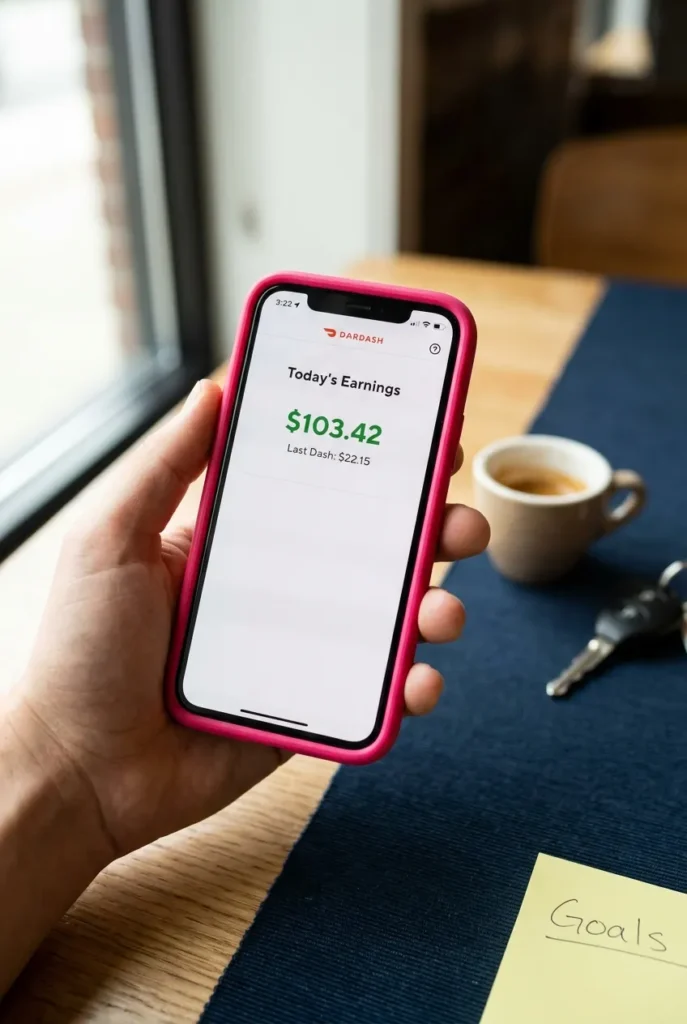
This is the framework that separates Dashers who burn out by month two from Dashers who keep going for years. The principle is simple: trade hours for density.
Step 1: Schedule the Two Peak Windows, Skip the Middle
DoorDash has predictable demand spikes in most US markets:
- Lunch rush: 11:00 AM to 1:30 PM (Tuesday through Friday, plus Saturday)
- Dinner rush: 5:00 PM to 8:30 PM (Sunday is often the strongest)
The dead zone between 2:00 PM and 4:30 PM is where new Dashers grind for $8 an hour and quit. Skip it. Schedule the two peak windows back to back on a Friday or Saturday and you’ve got a 6-hour day with most of the dollars baked in.
Step 2: Aim for Hot Spots, Not Just Any Open Zone
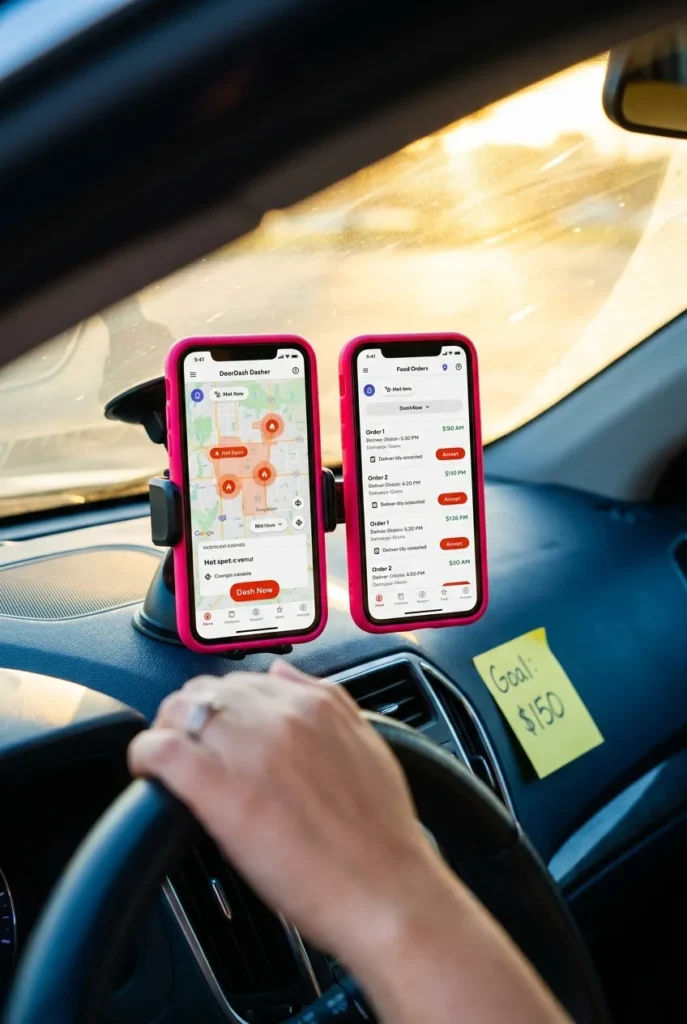
The Dasher app shows hot spot icons (the orange waves) inside the map. Park near one before your scheduled time starts. If you live 15 minutes from the nearest hot spot, account for that travel in your hourly math. Free lesson from me: I lost $40 worth of peak time my first month sitting at home waiting for pings instead of driving to the demand.
Step 3: Decline Strategically (the $1.50 Per Mile Rule)
Acceptance rate affects your access to Top Dasher status and some priority programs, but it does not change your base pay on individual orders. The math on a good order is roughly $1.50 per mile minimum. Anything under that drains gas and time.
My personal rule: if it’s under $6 total payout for over 4 miles, I decline. If it’s a $4 order to a known stiff-tipping zip code, I decline. Your local sweet spot will look different. Track 20 orders, calculate the dollar-per-mile, then set your floor.

The Multi-App Trick (DoorDash + Uber Eats Stacked)
If you’re going to sit in your car for 4 hours, you might as well let two apps fight for your time. This is the trick most Tier 2 and Tier 3 Dashers use to push from $80 days into $100+ days without adding hours.
Here’s how I stack apps without breaking either platform’s terms:
- DoorDash is the anchor. You schedule peak windows there and run them as your primary.
- Uber Eats sits in the background on Dash Now mode equivalent. When you’re on an active DoorDash delivery, you pause Uber Eats. When you’re idle waiting for a ping, Uber Eats is hunting.
- Never accept overlapping orders. Both platforms penalize late deliveries. Take whichever ping comes first, complete it, then re-enable the other app.
On a strong Saturday dinner shift, multi-apping has added $20 to $35 to my take-home without adding hours. It does add screen-switching stress, so try it on a slower weekday first.
If weekend hours are your sweet spot, you’ll find this pairs well with other weekend side hustles that pay cash by Sunday night when you want to diversify beyond delivery.
The Real Take-Home: What $100 Gross Actually Means
This is the section every competitor skips. Let’s run the actual numbers.
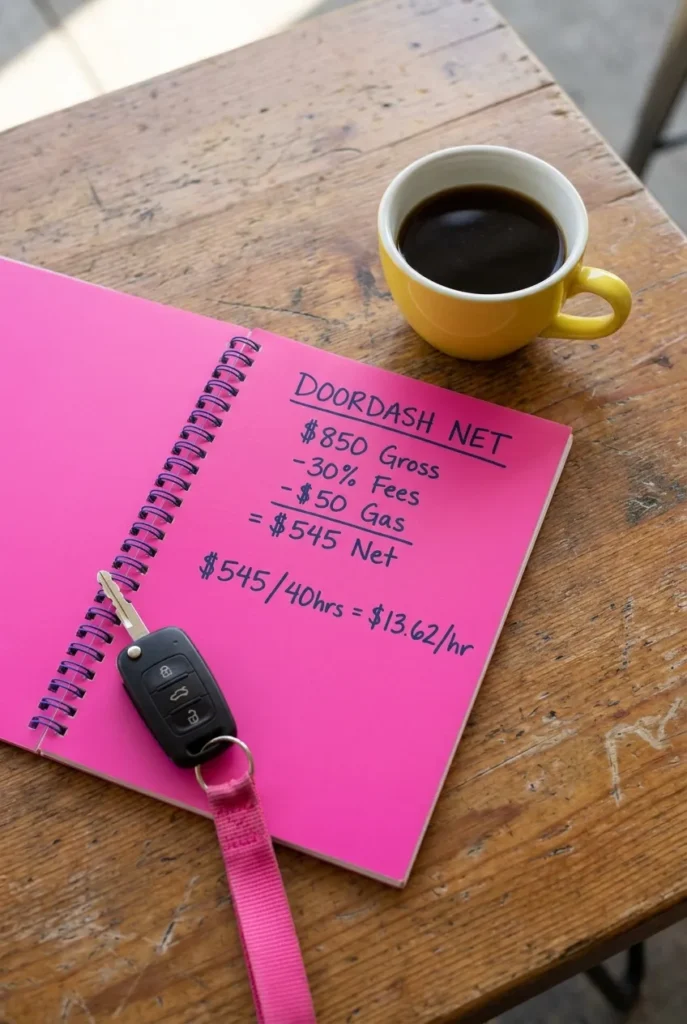
Say you Dashed 5 hours, drove 60 miles total, and grossed $100 in DoorDash earnings (base pay plus tips, no peak pay bonus). Your vehicle gets 28 MPG. Gas is $3.40 a gallon in your area.
Gross earnings: $100.00
Subtract these real costs:
- Gas (60 miles ÷ 28 MPG × $3.40): $7.29
- Vehicle wear and tear (rough estimate, $0.10 per mile): $6.00
- Self-employment tax (15.3% on net business income): about $12 to $14 depending on your full-year picture
- Federal income tax (varies by bracket, often 10% to 12% for part-time Dashers): roughly $8
Estimated take-home: $64.71 to $68.71
That feels deflating until you remember the mileage deduction. The IRS allows you to deduct the standard mileage rate per business mile driven, which for the 2025 tax year is 70 cents per mile (verify the current rate on IRS.gov before filing). On 60 miles, that’s a $42 deduction against your $100 gross. Your taxable income drops to $58, which cuts your tax bill meaningfully.
That mileage deduction is the single biggest reason serious Dashers track every business mile. Use a free app like Stride or pay for Everlance. Don’t trust your DoorDash mileage report alone, it does not always capture the miles between deliveries or the drive to your hot spot.
The Math: How Many DoorDash Orders for $100?
This is one of the most-searched questions, so let me give you a real answer instead of a vague estimate.
The average DoorDash order pays the Dasher between $4 and $12 once you add base pay plus tip. Peak pay bonuses on Friday and Saturday dinner can push the high end to $15 to $18 per order in some markets.
Plain math:
- Low average ($6 per order): roughly 17 orders to hit $100
- Mid average ($8 per order): roughly 13 orders
- Strong shift average ($10+ per order): 10 orders or fewer
In a 4-hour peak window in a Tier 1 city, I’ve seen Dashers complete 12 to 14 orders. In a Tier 3 college town, the same 4 hours might net you 7 to 9 orders. Order count is not the metric to chase. Dollar per hour is.
What About $1,000 a Week or $200 a Day?
If $100 a day is your floor, $200 a day and $1,000 a week become reasonable stretch targets, but they require a shift in how you Dash.
To hit $200 a day on DoorDash alone, you generally need to work 8 to 10 hours covering both peak windows plus a late-night shift in a strong market. Multi-app stacking shaves that down to 7 to 8 hours. Burnout risk is real. Most Dashers I know who push $200 days do it two or three times a week, not seven.
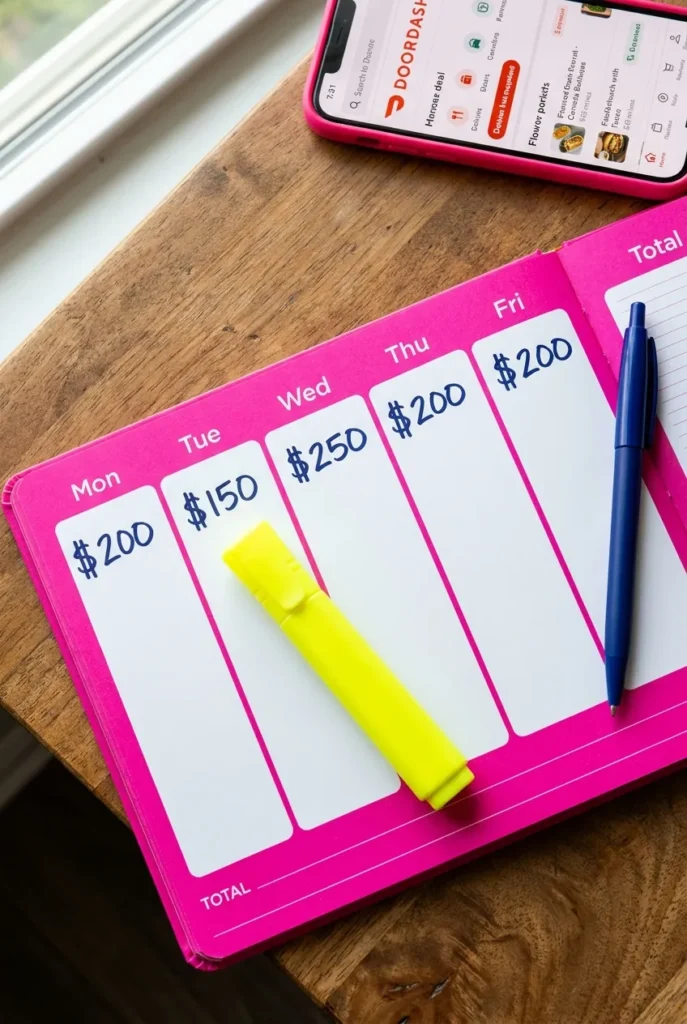
To hit $1,000 a week, the math is $143 per day for 7 days, or $200 per day for 5 days, or $250 per day for 4 days. The 4-day model is the one most full-time Dashers settle into because it preserves rest days and keeps your car maintenance manageable.
If your real goal is a steady monthly side income rather than maxing daily output, the framework in how to make $500 a month from a side hustle: a realistic 90-day plan builds the slower lane into your week.
When DoorDash Pays You (Daily vs Weekly)
This one trips up new Dashers. DoorDash offers two payout methods:
- Weekly direct deposit: Standard. Your earnings from Monday through Sunday land in your bank account the following Tuesday or Wednesday. No fee.
- Fast Pay: Cash out daily for a $1.99 fee per transfer, to a linked debit card. You can transfer once per day.
- DasherDirect (where available): A no-fee daily payout option through a prepaid Visa card issued by DasherDirect.
If you’re Dashing to cover a bill due Friday, Fast Pay or DasherDirect makes sense. If you can wait, the standard weekly deposit costs you nothing.
Gear Checklist: What You Need to Hit $100 Days Consistently
I learned this the hard way. The wrong gear costs you orders. Here’s the minimum stack:
- Insulated hot bag (DoorDash sells the red one, any large insulated tote works)
- Phone mount for your dashboard (under $15 on Amazon)
- Backup phone charger in your car (a dead phone is a dead shift)
- Reusable water bottle (peak shifts are 4+ hours, hydration matters)
- Comfortable shoes (you’ll walk into restaurants and up apartment stairs more than you think)
- Mileage tracker app (Stride is free, Everlance has a paid tier with auto-tracking)
Total upfront cost if you start from zero: under $40. Most of it pays for itself in the first peak shift.

The 1099 Tax Reality Every Dasher Must Know
DoorDash classifies you as an independent contractor, not an employee. That means:
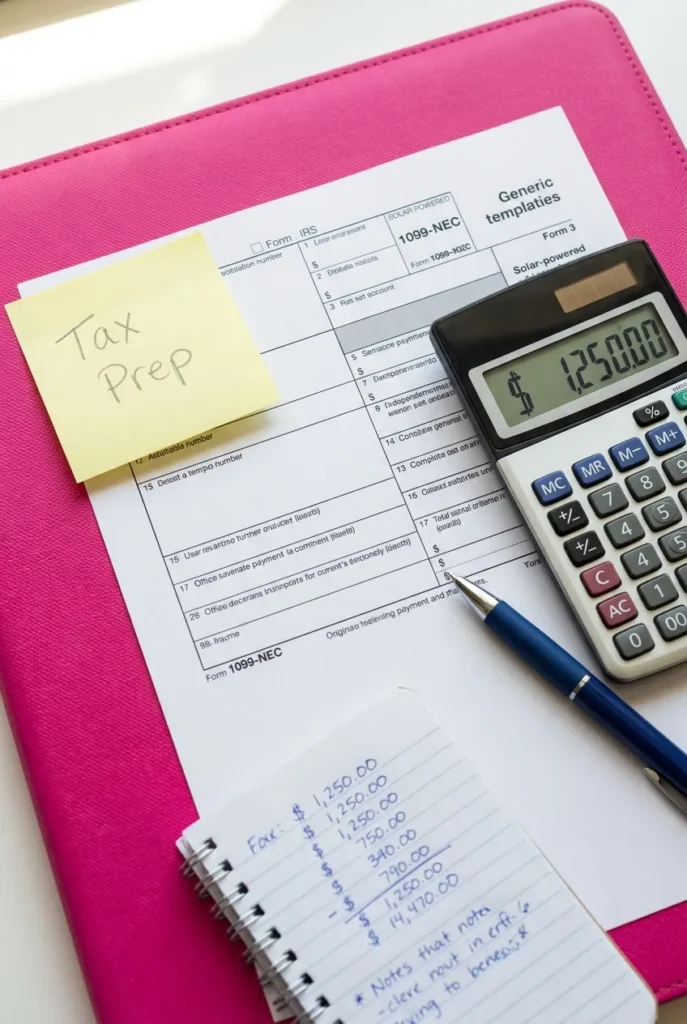
- You’ll receive a 1099-NEC from DoorDash if you earn $600 or more in a calendar year
- You file taxes using Schedule C (Profit or Loss from Business) as part of your annual 1040
- You pay self-employment tax of 15.3% on net business income (this covers Social Security and Medicare, the portions your employer would normally cover at a W-2 job)
- You can deduct business expenses, including the IRS standard mileage rate, phone bill portion used for Dashing, hot bag cost, and other gear
The federal threshold for reporting self-employment income on your tax return is $400 in net earnings, not $600. The $600 number is the threshold for DoorDash issuing the 1099-NEC. Even if you earn $500 and don’t get a 1099, you’re still required to report it.
A small surprise that’s bitten plenty of new Dashers: there is no automatic withholding. The IRS expects quarterly estimated tax payments if you’ll owe more than $1,000 for the year. Set aside 25% to 30% of every DoorDash payout in a separate savings account so April doesn’t sting.
This is general tax information. Consult a qualified CPA or US tax professional for your personal situation. Tax law and rates change. Verified accurate as of November 2025.
For complete official guidance on independent contractor tax obligations, see the IRS Self-Employed Individuals Tax Center.
The 7 Habits of Dashers Who Hit $100 a Day Without Burning Out
After Dashing across two markets and talking with dozens of Dashers in DoorDash subreddits and Facebook groups, these habits repeat:
- They schedule, they don’t Dash Now. Top Dasher status and scheduled shifts unlock priority order routing.
- They drive a fuel-efficient car. A 35 MPG car versus a 22 MPG truck doubles your gas margin.
- They track every mile. Stride, Everlance, or a paper logbook, never the DoorDash app alone.
- They batch errands with peak windows. Grocery store at 11 AM is 30 minutes before lunch rush starts.
- They cap shifts at 5 hours. Fatigue causes accidents. Accidents end the side hustle permanently.
- They keep a separate Dashing bank account. Easier tax accounting, clearer dollar tracking.
- They reinvest 10% into the hustle. Better phone mount, dash cam, a new pair of sneakers. Small upgrades compound.
Unlike printables or affiliate marketing, gig delivery is active income. Your time and miles are the product. If you want to layer in something less active eventually, see realistic passive income ideas that actually pay for slower-but-stackable streams.
FAQ: Real Questions Real Dashers Are Asking
How many hours of DoorDash to make $1,000 a week?
In a Tier 1 market with peak-hour scheduling and multi-app stacking, roughly 35 to 45 hours. In a Tier 2 market, 45 to 55 hours. In a Tier 3 market, hitting $1,000 a week on DoorDash alone is tough and may require a second platform like Uber Eats running parallel for most of those hours.
Do I need to report DoorDash income if it’s less than $400?
You won’t receive a 1099-NEC from DoorDash if you earned under $600, but the IRS requires you to report self-employment income of $400 or more on your annual return. Below $400 in net earnings (after expenses), the federal self-employment tax reporting threshold is not triggered, but you may still need to include the income for state tax purposes. Always confirm with a CPA.
Can you make $120 a day on DoorDash?
Yes, in most US markets. Add one extra peak window or a Friday night dinner rush in a strong tipping zip code, and $120 becomes a realistic stretch from a $100 day. Multi-app stacking is the most reliable way to push the number up without adding hours.
How many DoorDash orders do you need to do to make $100?
Roughly 10 to 17 orders depending on your market and time slot. Strong tipping zip codes during dinner rush often produce $10+ orders, which means 10 deliveries clear $100. Slower zones may need 17 to 20.
Can I Dash without a car?
Bike and scooter Dashing is available in select dense urban markets like Manhattan, Brooklyn, and parts of San Francisco. Earnings are lower per hour, but your costs are also lower. For most US Dashers, a car remains the strongest setup.
Does DoorDash pay for gas?
No. DoorDash does not reimburse fuel costs. Your mileage deduction at tax time is your offset. Some markets occasionally run fuel rewards programs, but treat those as a small bonus, not core income.
Is multi-app stacking against DoorDash’s terms?
DoorDash’s Independent Contractor Agreement allows you to work for other delivery platforms. It does prohibit accepting overlapping orders or letting one delivery delay another. Stack carefully and you’re fine.
The Bottom Line on Making $100 a Day on DoorDash
You can absolutely hit $100 a day on DoorDash. The Dashers who do it without burning out treat the gig like a small business, not a button to mash. They schedule peak windows. They decline bad orders. They track every mile. They keep one eye on the take-home, not just the headline.
Start with one peak Saturday. Track your hours, miles, tips, and gas. Run the take-home math at the end of the shift. Adjust next weekend. By week three you’ll know exactly which windows in your zip code produce $25 hours and which ones don’t.
What’s your local market tier, and which peak window are you Dashing first?